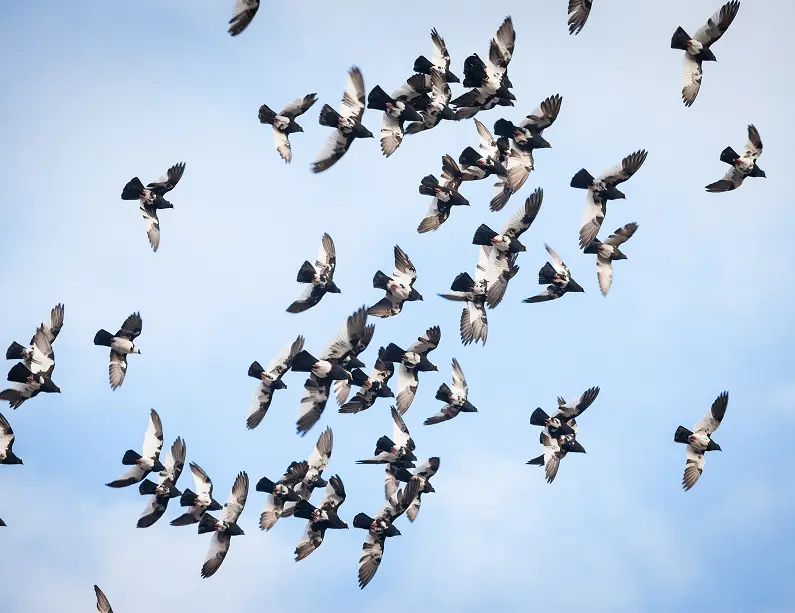
Welcome to your trusted source for racing pigeon nutrition. Discover how a well-structured feeding plan can help your birds soar to their full potential.
INTRODUCTION
As in many cases in life, one is always confronted with the question
“WHAT IS THE TRUTH”?
This is so when you just consider everyday occurrences:
➢ Did our government know beforehand if Pearl Harbor was going to
be attacked?
➢ Why was the Trade Center attacked?
➢ What was Covid about?
➢ Who was involved with Jeffrey Epstein?
I am not trying to start any conspiracy issues or become political in any way. I am just asking “what is the truth” and I am sure there are many versions of the truth. Likewise, when you get to the feeding methods of pigeon feed regimes – there are many versions of what is and what may be successful. Then why is it that fancier A feeds a certain way and is successful but yet fancier B feeds the same way but remains unsuccessful? When I purchase good pedigreed pigeons from fancier A, I do not get the results that he had with the same pigeons? Why is it that on some races my birds have good results but on others they do not? Is it because some weeks they have a better pedigree but on others they are not good enough?
These are all good questions, and they need to be asked if you are a serious fancier and no matter if you are interested in the sport for the love of it or in the sport for being competitive. Everyone wants to be a winner and rightly so – the sport becomes a whole lot nicer if you are able to win.
In my humble opinion – the old saying by OLD HAND
HE WHO MASTERS THE ART OF FEEDING – MASTERS THE ART OF RACING.
I have been in the same position as many of you are – I listen to this fancier who has success and invariably there is no improvement in the results. I am not saying that experienced fanciers tell mistruths as to their feeding regimes; but are they being honest?
I took it upon myself to identify, based on science, how to feed according to my own circumstances. On the one hand, each fancier has the ability to determine what I call the OUTPUT coefficient by managing the workload of each pigeon for the week. This encompasses the output in the number of minutes he is expecting his pigeon/s to fly each week. Each fancier has their own determination as to what is expected. This equates to race distance, speed of the race, road training, and loft exercise.
I spent several years in Belgium to find out as much as I could on this subject. I desire to inform all fanciers that I believe I have found a system that works – the first of its kind that gives everyone the correct methods of determining their own OUTPUTS vs INPUTS.
Once the output has been determined you have to manipulate the INPUT. This means that you must determine what seed types you should be feeding and at what quantity you should be feeding the selected seeds.
The OUTPUT must equal the INPUT for your pigeon to be able to compete successfully. There are also some other major issues that will be discussed further on.
Many fanciers are “at a loss” as far as the correct feeding schemes are concerned. One guy may feed this type of mixture and feed at say 30 grams per pigeon per day and have success. Another feeds on a “hopper” system and has success. You hear all sorts of stories and while you are in “the dark” (so to speak) your pigeons are not getting the correct feed, and their genetic potential is not being realized. This leads to confusion and doubts as far as whether your birds have the correct genes and when you start reading about different seed mixtures and the various protein, fat, carbohydrate contents it all becomes a little difficult to understand. Add to these the endless rumors’ regarding the amount of road training some guys do, and you end up with a huge question mark, “What do I do? Where do I change? What is the truth?
Never has anyone given out the correct information and many (if not all) successful fanciers keep their methods very “close to their chests” which is quite understandable.
“In my opinion, 75% of success lays in the feeding method” – the saying “you are what you eat” is especially true when it comes to successful pigeon racing.
Below, I will give you the guidance required and to work out your own feeding schemes that fit into your own particular circumstances. Some fanciers have much time on their hands to road train frequently while others do not, some may be able to afford to pay for tanking fuel while others may not. Some race only the speed (short distance) races while others race only mid fond and fond races (middle- and long-distance races). Here is a feeding system that accommodates all these variables and works out exactly what you should be feeding and how much you should be feeding.
Theory
There are a few things that you need to understand. The theory is based on NEW European thoughts –
Pigeon Muscles
At the University of Gent in Belgium it was discovered that the racing pigeon has two types of muscle cells – red muscle cells which make up approximately 85% of the pigeons’ total muscles and white muscle cells which make up approximately 15% of total muscles structure. By getting pigeons to fly in a wind tunnel and being able to measure the usage of muscles it was found that the white cells are used for the pigeon getting started – i.e., reaching a height and flying speed over the first approximately 60 minutes. It was also found that these white cells use glucose reserves for fueling the energy requirements. The red muscle cells are used for the balance of the race time, and these cells are fueled from fat reserves. It was also found that a pigeon flying requires 3,5 grams of fat per hour flying. Now this information is what makes me (and I am sure you) very excited. One needs to convert this information into practical usage. This cannot be done by the everyday fancier. This data allows you the freedom of manipulating the feed according to the minutes expected on the wing.
Allow me to give you an easy-to-understand example: Say you need to prepare your pigeon for a 500km race the coming weekend and the expected speed would be around 1300 mpm. That equates to 384 minutes. Now deduct the 60 minutes your pigeon has utilized its carbohydrate reserves whilst flying on the white muscle cells, from this time – leaves you with 324 minutes which equals 5,4 hours. These hours are raced on the energy fueled by the fat reserves of the red cell muscles, and we have the theory that the pigeon uses 3,5 grams per hour, so the pigeon needs 18,9 grams of fat to complete the race.
Training
The program allows you to enter the amount of training you as manager does with the pigeons. The understanding is that minutes flown around the loft (circling) is judged to be at 75% exertion rate and minutes done by road training is calculated at 100% exertion rate. Both methods should be used at various times of the week. If one or two training days are unable to be reached because of severe weather conditions, you would be expected to reduce the training time accordingly and obviously reduce the fat content of the feed. Similarly, you may not be able to train at all – the fat fed must then be reduced.
Too much fat
It is important also to not feed your athletes too much fat. Let me give you an example: When a Formula 1 car is racing it is fueled for the number of rounds to be done – the weight of any excess fuel which is not required will reduce the speed at which it completes the rounds – the same is for the pigeon – too much fat will slow the pigeon down and very quickly you will have an “out of form” bird.
Quantity feed fed
This has always been a problem for most fanciers. The answer lies in what is fed – if you are a heavy feeder you need to reduce the k/cal and fat content of the feed and conversely – if you are a light feeder then you need to make sure your birds are fed the correct mixture with correct fat and k/cal contents.
Health
It is a well-known fact that STRESS is the main cause of health issues when it comes to pigeon racing. By feeding your pigeons in the correct manner – giving them the correct feed to successfully complete the task at hand – put less stress on them ensuring a better health. So often fanciers start the season with a “bang” just to fade out after a few races. I put this down to improper feeding leading to health issues which lead to poorer results – leading to questions regarding the genetic potential of your flock.
Suggestions
Keep to the following guidelines:
Short Distance Middle Distance
Fat 4.3 7.8
Protein 12 14.5
K/cal (per 35 grams per day) 105 120
_____________________________________________________________
Feed Mixes
Should you have limited access to individual seed types and are reliant in feeding an already mixed feed – do not rely on the sticker when determining the make-up of the ingredients – rather weigh an exact sample of mixture (Say 1kg) – then by hand sort each seed type into its own group – weigh each group and then work out the percentage of the total (1kg) – enter this data into the program. Make sure the bottom column total = 100. Then adjust the quantity of feed being fed by dropping up or down the quantity cell for the day you have chosen to feed this mixture (data entry). This will give you the exact result you need when determining the INPUT according to the OUTPUT entered. I will almost guarantee that most of the fanciers are vastly overfeeding their pigeons.
I had a fancier come up to me at the recent AU Convention in Chicago. Apparently, this fancier and his family (father, uncle and grandfather) are rated as the most successful fanciers within the USA. (I will not mention his name). He asked me to enter his feeding regime which contained only barley, white sorghum and safflower. He was very surprised when I informed him that his feeding system was almost spot on. I told him that he may not be as competitive on the short distances because he was not feeding “sharp” enough. In my opinion, and according to the result shown by the program, his protein content was also a little lower than it should be with the result that his birds would not be able to be entered into races on a weekly basis. The muscles would deteriorate with a lessor protein level. He mentioned that the information gleaned from the program was “SPOT ON”. He had apparently requested a well-known seed mixer to mix this mixture for him. They denied his request because they were of the opinion that a mixture like this would never be fed with success. Again – what is the truth?
After the day of barley only – increase protein levels slightly and then reduce these levels again with 3 feeds before basketing – protein seeds require at least 72 hours after being fed to be metabolized by the pigeon – the increased protein cycle must be complete 3 feeds prior to basketing day. One can make use of animal proteins in this period with great success – animal proteins like whey proteins, cheese and sheep fat pellets, other protein powders from animal origin – these are metabolized within 20 minutes after digestion. The last three feeds must be increased carbohydrates and fats feeds. Exercise the pigeons well whilst feeding the protein cycle and reduce exercise with good rest prior to basketing.
When you basket your pigeons for an overnight race (i.e., only one night in the basket) then the pigeons should have no feed in their crop at basketing – last feed only the morning if basketing is that night.
When your pigeons are basketed for two nights in the basket – say Thursday basketing for Saturday liberation then the pigeons should have their normal feed (20gms each) in the afternoon of basketing day.
Consider the importance of “mastering the art of feeding” at a small initial purchase price but knowing that this important “pillar” is addressed in the correct feeding method. “A small price to pay for success”?
How?
The next step to understanding this feed system is to make the purchase. The program is on the website www.racing-pigeonfeed.com – you will receive a password which is unique to your program and cannot be copied. “After sales service” is available via email only and in time FAQs will operate on the website. The purchase of the program is a “once off” purchase that allows you unlimited access via the website to be used as often as you require.
I believe this “calculator” is a tool that every fancier should have in his/her arsenal to be used every day / week. Old experienced and new young fanciers should use this valuable tool in ensuring the correct feeding protocol of their pigeons.
I invite you to visit the website. www.racing-pigeonfeed.com to explore how to feed your race birds according to the amount of work is expected from your birds per week. INPUT (amount of correct feeding) = OUTPUT (number of expected minutes)